
Quantifying AMOC uncertainty in European climate damage projections
in preparation
Abstract
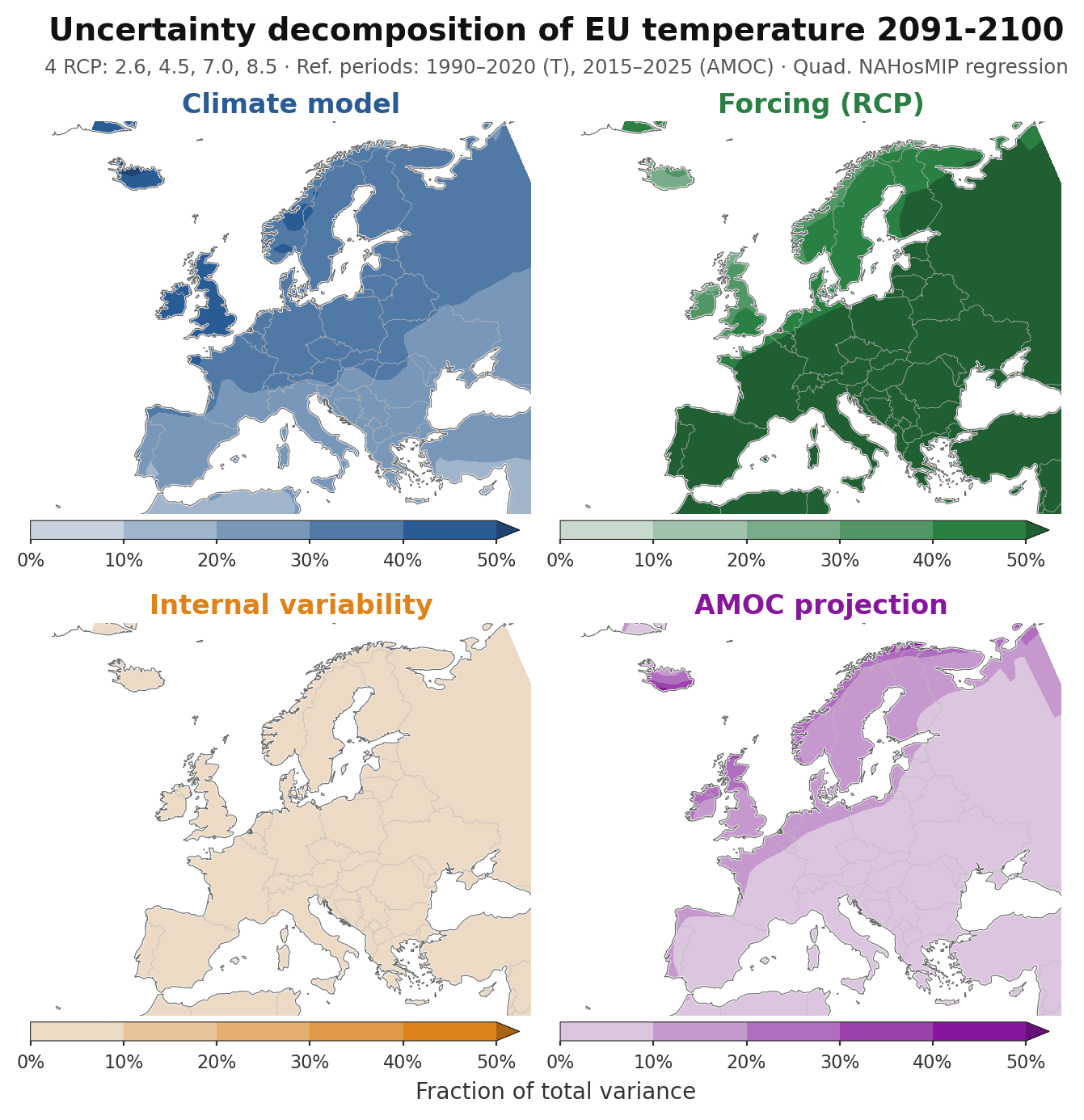
Projections of economic damages from climate change in Europe are increasingly used by central banks, ministries, and adaptation planners. These projections depend on temperature projections, which are subject to scenario uncertainty, climate model uncertainty, and damage function uncertainty. An additional, often implicit source of uncertainty is the projected, yet poorly constrained, weakening of the Atlantic Meridional Overturning Circulation (AMOC), which would lower European temperatures and thereby alter damage estimates. Here, I explicitly quantify the contribution of AMOC uncertainty to total European damage uncertainty. I develop a pattern-scaling emulator of the spatially resolved European temperature response to AMOC weakening, calibrated separately for eight Earth system models from the North Atlantic Hosing Model Intercomparison Project (NAHosMIP). Combining this emulator with temperature projections from over 20 CMIP6 models, AMOC projections from a similar number of models, three emissions scenarios, and four empirical damage functions, I decompose the variance in projected end-of-century European climate damages into contributions from scenarios, models, AMOC behaviour, and damage function choices. I find that AMOC uncertainty accounts for approximately 10–15% of total damage variance across Europe, with its contribution peaking in the British Isles and along Atlantic coastlines, where it rivals scenario uncertainty. Damage function uncertainty is the largest contributor overall, particularly in Scandinavia, while scenario uncertainty dominates in Mediterranean Europe. These results suggest that the common practice of omitting AMOC uncertainty from regional damage projections underestimates total climate damage uncertainty, especially for Northern and Western Europe.
Recommended citation: Schaumann, F. (in prep.). "Quantifying AMOC uncertainty in European climate damage projections."