
Towards comprehensive economic assessments of climate change impacts
Published in Economics of Disasters and Climate Change, 2026
Direct link to the paper (open access): DOI: 10.1007/s41885-026-00205-y
Abstract
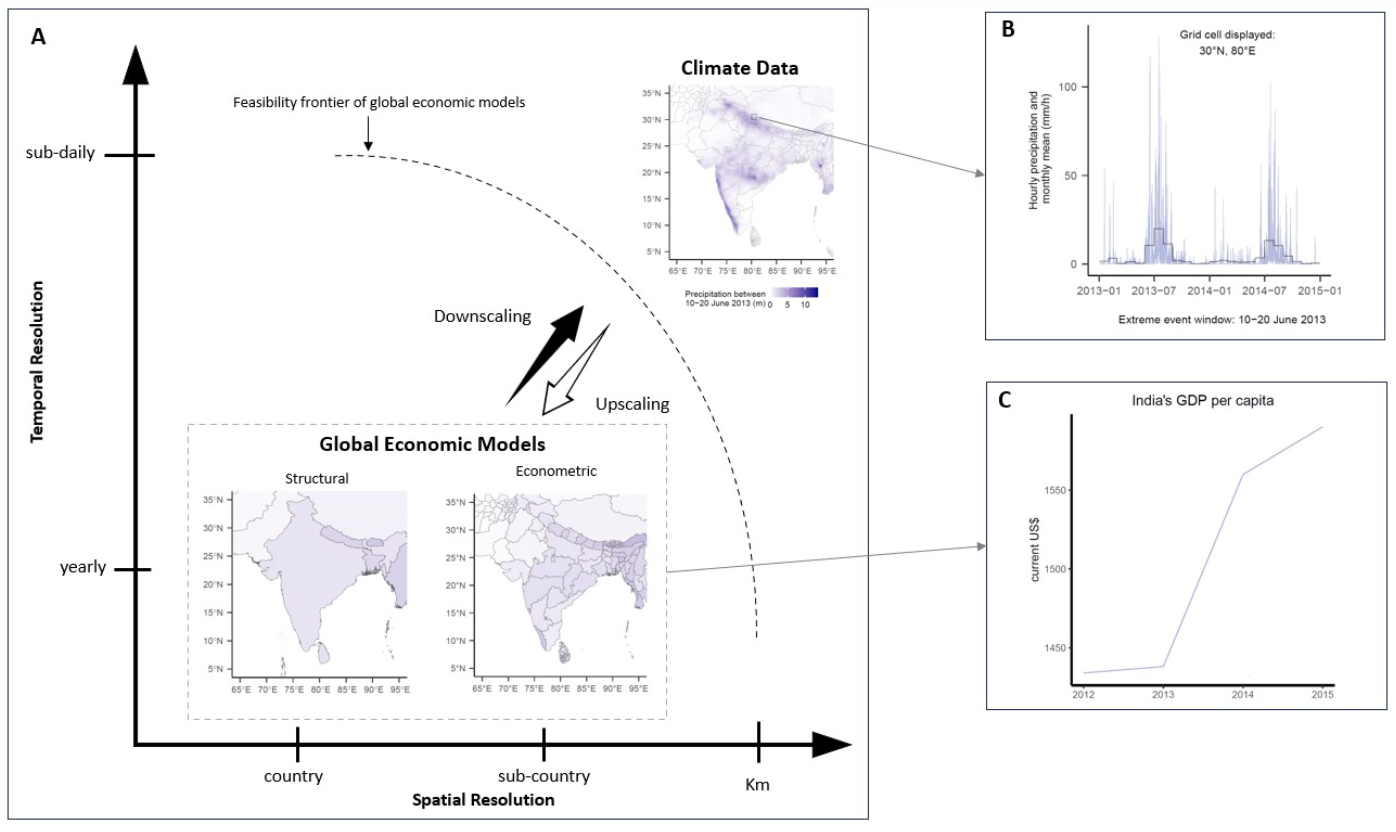
Robust and comprehensive economic assessments of climate change impacts are essential for effective mitigation and adaptation policy. However, estimates of economic impacts remain highly uncertain and vary substantially across modelling approaches. To increase transparency and cross-disciplinary understanding, we review the key strengths and limitations of widely used economic modelling approaches. We find that none of the modelling approaches can comprehensively assess both direct and indirect impacts of climate change, particularly those caused by climate extremes, across spatiotemporal scales. Modelling approaches typically face trade-offs between broad regional and sectoral coverage and high granularity. Yet, there is a growing need for assessments that link asset-level impacts to cross-regional and cross-sectoral spillover effects. Future research should focus on: (i) better quantifying the persistence of climate change impacts on economic output, (ii) integrating often-omitted climate hazards, (iii) improving the representation of interactions among environmental, social, economic, and financial systems, and (iv) advancing cross-sectoral adaptation modelling across scales. We propose a modular, multi-scale integration of complementary modelling approaches that can enable more comprehensive assessments of socioeconomic impacts from local to global scales and improve the representation of persistent climate impacts on socioeconomic development. The proposed framework can support more robust evaluation of mitigation and adaptation policies and better guide decision-making.
Recommended citation: Orlov, A., Blanz, B., Borchert, L., Waidelich, P., Drupp, M.A., Schaumann, F., Avakumović, V., Sillmann, J. (2026). "Towards comprehensive economic assessments of climate change impacts." Economics of Disasters and Climate Change, 10(2), 27.